

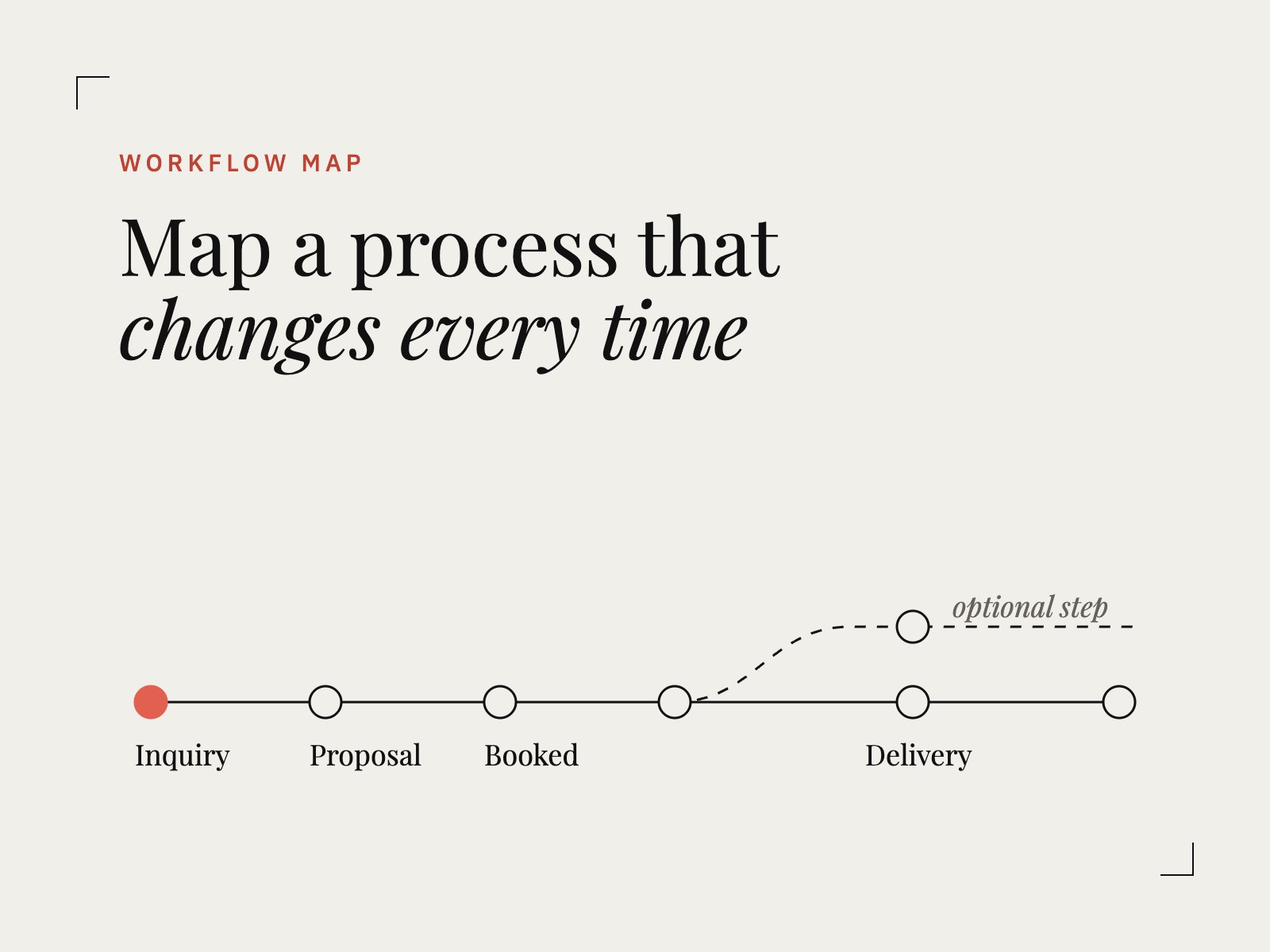
The most common reason people do not map their process is the belief that they do not have one. Every client is different. The scope moves. Some skip the discovery call. One wanted the invoice split three ways.
So mapping feels dishonest, like drawing a straight line through something that is genuinely not straight.
That belief is the thing standing between most service businesses and a system, and it is worth taking apart properly.
Variation is not the same as having no process
Work through what actually changes between two recent clients and you will usually find the differences sit in a small number of places: scope, timeline, price, and occasionally one optional step.
The rest is identical. The inquiry arrived somewhere. You replied. Something was signed. Money moved. You delivered. It ended.
That skeleton is the process. The variation lives inside the steps, not in the order of them, and a Workflow Map captures the order.
If your service runs in Dubsado, How to Map a Dubsado Workflow Before You Build It turns that order into actions, triggers, and timing.
Map the version that happens most
You are not writing a policy that binds you. You are describing what usually happens so you can automate the parts that always happen.
Pick the most recent client whose project went normally. Not the smoothest and not the disaster. Map that one. If seven of your last ten looked roughly like it, you have found your main sequence.
The other three are exceptions, and exceptions are handled after the main sequence exists, not before.
Three kinds of variation, and what to do with each
Variation in content
Different scope, different deliverables, different prices. This is not workflow variation at all. Smart fields and packages handle it, and one email that pulls the selected package beats four hand-written versions.
Variation in timing
Some clients take a week to sign, some take a month. This also is not workflow variation. Workflows already wait. A step that fires on contract signed does not care whether that took two days or thirty.
Genuine branch points
A client either books a discovery call or does not. A project either includes prints or does not. These are real, and there are usually fewer of them than you expect.
Handle them by mapping the main path, then noting where it forks. Most forks turn out to be one optional step that can simply be skipped rather than a separate process.
The test for whether it is really a different process
If two services share a sequence and differ only in what gets sent, they are one process with different content.
If they stop and wait in different places, or the money moves at a different point, they are genuinely different, and they get mapped separately.
Most businesses that believe they run five processes are running one process and two.
Map one, then add the others
Start with the service you sell most often, mapped as a single sequence. Get that built and running with real clients. It will not fit every project exactly, and it does not need to. It needs to fit most of them, so the exceptions are exceptions rather than the entire job.
Then map the next service into the same system rather than beside it, and the shared pieces stay shared.
Messy is the normal starting point
Nobody maps a process that is already tidy. Tidy comes after, and mapping is what makes the mess visible enough to fix.
Map what happens now, not the process you have been meaning to run. An aspirational sequence produces a system for a business you do not operate, and you will not build it.
Map Before You Build is free and assumes exactly this starting point. You settle one service, inconsistencies included, then generate a build-ready Workflow Map for it in Dubsado Alchemy at no cost.

